

From Paper to Platform: The Digital Alignment Changing Global Port Operation
Estimated Reading Time: 4 minutes
For decades, the global supply chain moved only as fast as its slowest physical document. Ports, the critical gateways of international commerce, struggled with coordination barriers that fueled delays, disputes, and hidden costs. Today, that friction is being systematically eliminated. A new era of trade coordination has emerged, and the convergence of regulatory transparency, digital documentation, and sophisticated data platforms defines it. This evolution is fundamentally altering how cargo moves, how charges are authenticated, and how trade partners coordinate critical decisions.
The Digital Alignment: Reimagining Port Operations
A fundamental shift is underway across global ports. This pivotal change hinges on digital alignment and on actively connecting ports, shippers, and inland depots. The confluence of rising pressure for transparent logistics charges, the decisive move toward digital documentation, and the rapid adoption of electronic Bills of Lading (eBLs) is collectively forging a shared operational language. Disparate processes are now linked: unified data, synchronized timelines, and shared digital records bind them inextricably.
Compliance is the Catalyst: Regulatory Pressure and New Transparency
Financial clarity is now written into the rules directing freight movement.
- Domestic Clarity: New FMCSA requirements mandate that brokers share electronic transaction records within 48 hours, detailing both the exact shipper charge and the broker's compensation. This enforces financial clarity within the domestic legs that connect to global port gateways. Source: https://www.fmcsa.dot.gov/regulations/docket-no-fmcsa-2023-0257-rin-2126-ac63-transparency-property-broker-transactions
- Global Standardization: This mandate extends beyond the U.S. Global frameworks, such as the WTO Trade Facilitation Agreement and G7/G20 digital trade principles, alongside legal reforms enacted in the UK, Singapore, Bahrain, the UAE, India, and others, are actively standardizing how digital trade documents are recognized and exchanged.
If a charge appears on an invoice, its underlying logic and source data must be digital, structured, and readily verifiable. Ports and inland depots are swiftly adapting to accommodate this expectation.
The Measurable Invoice: Digital Auditing and Financial Clarity
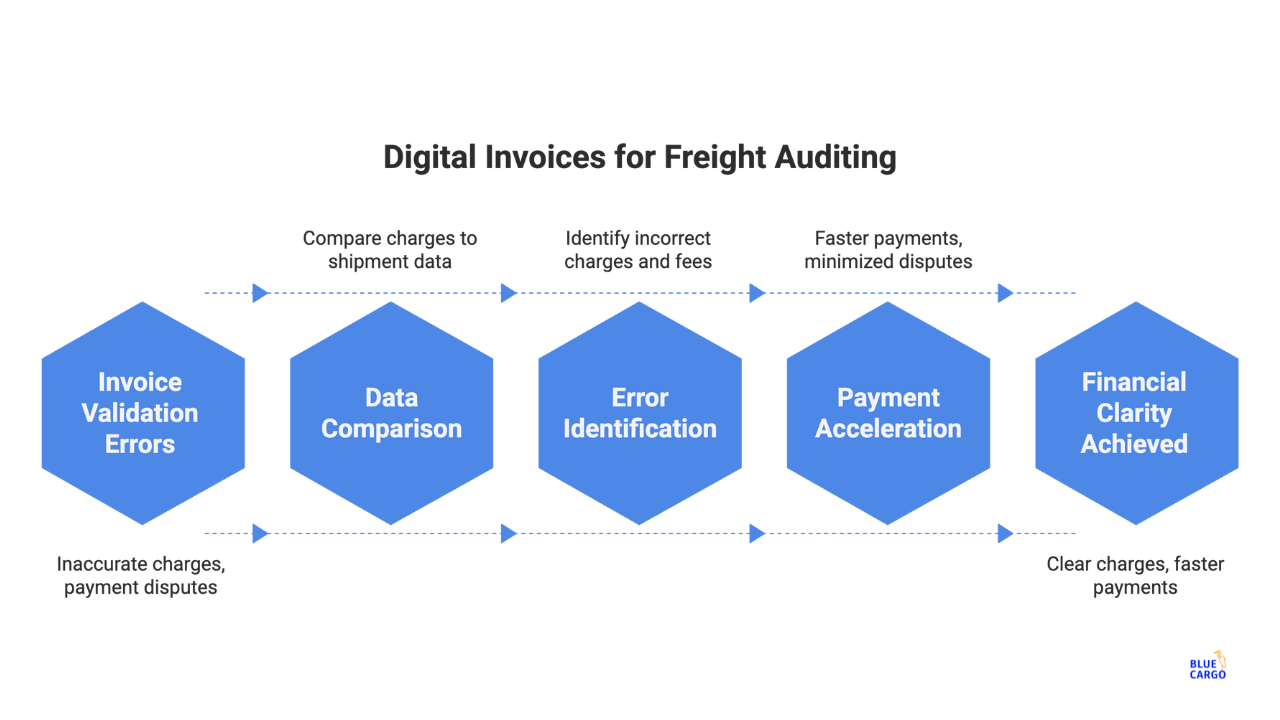
When core documentation shifts to a digital format, invoice validation achieves exceptional precision. Modern freight auditing tools meticulously compare every surcharge, critical milestone, and contracted rate against the precise shipment data and agreed-upon terms.
This capability empowers shippers to identify errors, including incorrect detention or demurrage amounts, rate inconsistencies, duplicate bills, misapplied fees, and discrepancies between actual events and billed services. We see at BlueCargo that this transformation directly impacts ports and inland depots, importers and exporters, and their vendors. When charges are unambiguously clear and substantiated by event data and time stamps, then payments are made faster, and the disputes are minimized. This creates a robust commercial incentive for Ports to align their documentation and event timestamps seamlessly with the digital records shippers maintain internally.
The Connected Ecosystem: Platforms Linking Bookings, Documents, and Operations
Digital freight platforms actively consolidate the critical information that was once migrated across isolated spreadsheets and complex email chains. These integrated platforms seamlessly merge key functions:
- Booking, rate management, and EDI and API document exchange
- Vessel schedules, shipment milestones, and exception alerts
- Cargo release updates, messaging, and collaboration
For ports and inland depots, this consolidation translates into ideal alignment with both upstream and downstream stakeholders. Should a vessel’s speed change mid-ocean, the inland terminal instantaneously receives that signal. Once customs releases a container, the trucking partner gets an immediate notification. This highly integrated environment is instrumental in reducing avoidable dwell time and limiting unnecessary accessorial charges.
The New Currency of Trade: Electronic Bills of Lading
The single most powerful development reshaping modern trade is the rapid adoption of Electronic Bills of Lading (eBLs). Traditional paper B/Ls often travel more slowly than the physical cargo itself, frequently forcing consignees and others to wait days (or weeks) for the original documents. These procedural delays generate D&D, slow down crucial transfers of ownership, and sometimes strain coordination with inland depots.
eBLs resolve this bottleneck by allowing documents to be transferred in minutes. The advantages of using them include:
- Speed: Faster circulation reduces storage risk and significantly accelerates cargo release.
- Adoption: Nine of the ten largest carriers have committed to achieving full adoption by 2030,including Maersk, MSC, and CMA-CGM.
- Legal Certainty: Legislation across multiple regions has enacted laws granting digital trade documents the same legal weight as paper documents.
For exemple, the United Kingdom (UK): The Electronic Trade Documents Act (ETDA 2023) made digital trade documents, including eBLs, legally equivalent to paper documents under English law, The Netherlands: In May 2025, the Dutch government introduced legislation granting eBLs the same status as paper bills. Several countries, including Singapore, Bahrain and the UAE have aligned their domestic regulation to be consistent with model laws like the UNCITRAL MLETR, thereby supporting the legal certainty of eBLs. - Interoperability: Initiatives such as PINT and shared registries enable eBLs to move fluidly across platforms, eliminating the barrier of working within a single provider.
eBLs have quickly become the de facto operating standard for global cargo.
Beyond the Gate: Linking Ports to Inland Depots with Digital Documents
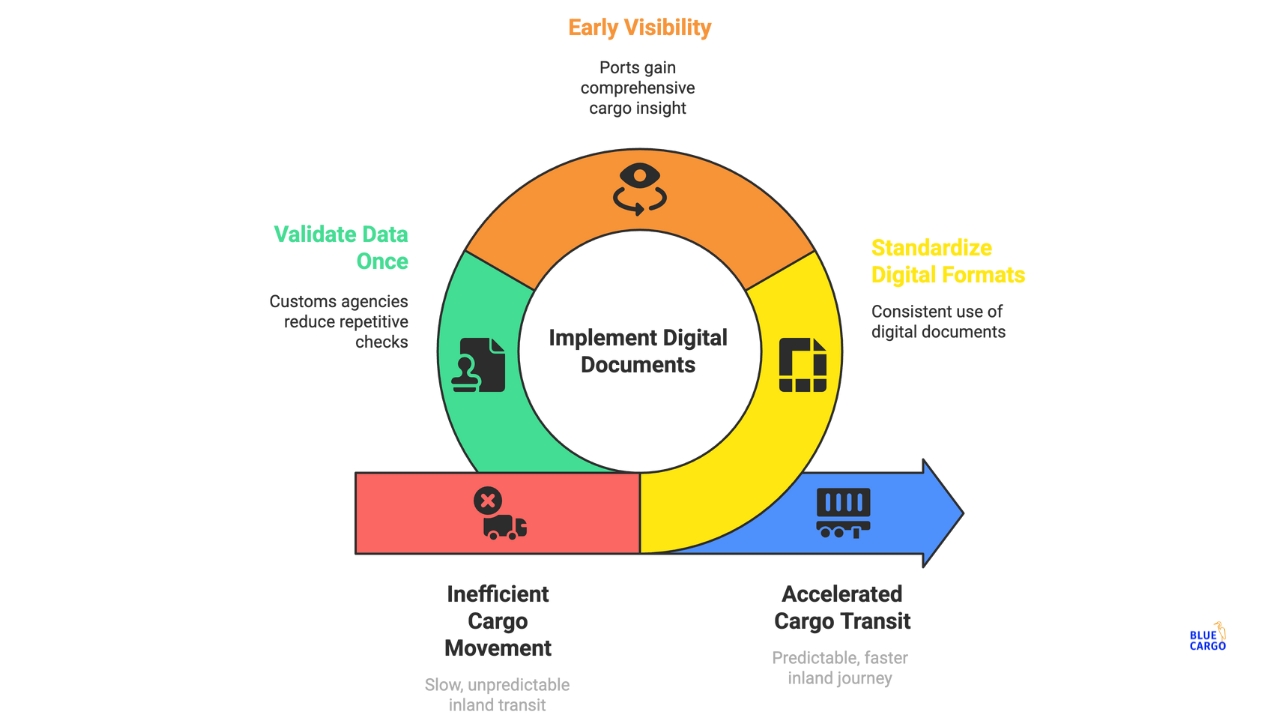
Coordination does not culminate at the terminal gate; it remains critically dependent on what transpires during the road, rail, and warehouse legs of the container’s journey. More than twenty key trade documents already exist in standardized digital formatsincluding commercial invoices, Sea waybills, Air waybills, Rail consignment notes, and electronic consignment notes for road transport.
When these digital formats are employed consistently, ports and depots gain early and comprehensive visibility into cargo clearance, inland movements, and required documentation. Furthermore, customs agencies can validate data once rather than requiring repetitive checks across multiple borders. This consistency dramatically improves predictability and accelerates the container's transit on its inland journey.
Unified Trade Corridors: Smart-Port Technologies and Visibility
Smart-port systems connect sensors, GPS, and sophisticated operational software to generate a unified, real-time view of the entire cargo flow. These cutting-edge technologies empower ports to coordinate crane moves with yard availability, align truck and rail dispatch with real-time container readiness, monitor fuel usage and route efficiency, manage predictive maintenance, support green corridor projects, and adjust operations efficiently during weather or political disruptions. The leading result from these smart systems is a truly coordinated trade corridor, replacing what was once merely a collection of isolated checkpoints.
A Leader's Blueprint: Priorities for the Next Phase of Digital Trade
BCOs, port operations, and inland logistics must now focus on an obvious set of priorities for the next phase of digital trade. The first focus is Documentation: preparing systems and workflows for eBL adoption at scale.
When it comes to pricing, the directive is to ensure all ancillary charges are explicitly defined through structured digital data. Adapting to such structure will enhance collaboration and companies need to look into digital platforms that already exist, rather than trying to do it on their own.
What is more, adopting will bring adherence to standardization, meaning the selection of partners will be aligned with frameworks. Operationally, the process requires developing internal procedures and training, which can be done with your partners’ digital teams, such as customer success managers.
Finally, for finance departments, businesses that integrate operational and financial visibility will clearly have access charges that accurately reflect real-world events.
The future of port coordination belongs decisively to those who treat digital records, transparent pricing, and shared data as operational essentials, not as optional upgrades.
BlueCargo assists importers and exporters by transforming complex freight invoices, ancillary charges, and digital documents into clear, verifiable data.
If you wish to improve accuracy, reduce preventable costs, and prepare your operations for the next phase of digital trade, schedule an AI Audit Review with our team.
→ Book your 15-minute Audit Review
---
Read our Cargoccino here.


