
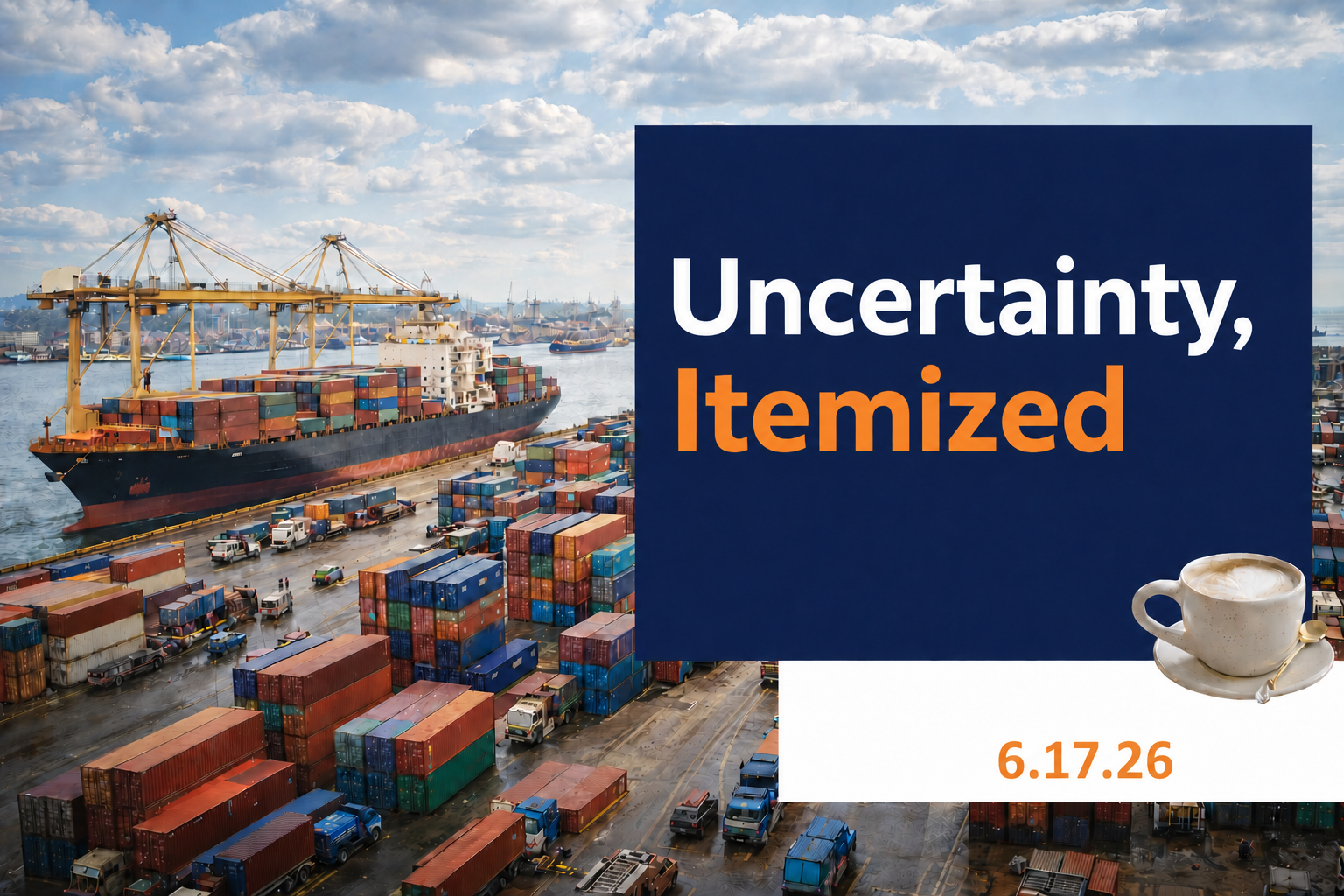
☕ Uncertainty, Itemized | Cargoccino 6.17.26
Courts are reinstating tariffs. Hormuz is technically open but practically closed. Importers are frontloading before the next shoe drops. And the port that handles 40% of US imports just cut its volume forecast while China's share keeps sliding. None of these stories are unrelated — they're line items in the same invoice. This week's Cargoccino breaks down four costs your freight bill probably isn't reflecting accurately yet.
Top of the Cup: 10% Tariff isn't Going Anywhere For Now
A federal appeals court reinstated Trump's 10% baseline tariff on all imports under Section 122 of the Trade Act of 1974, overriding a lower court injunction that had paused collections for two importers and the state of Washington. The appeals court called the lower court's reading of the statute too narrow and found the government had shown a strong likelihood of prevailing on the merits. The case isn't final, but it's the most favorable ruling yet for the administration's tariff authority — and the clearest signal that Section 122 levies are the floor, not a temporary detour.
Why It Matters: Every time tariff applicability shifts (by court ruling, executive order, or exclusion) importers face potential reclassification of what they owe. Carrier invoices often don't reflect those changes in real time, creating overpayment risk. BlueCargo's freight audit catches the delta between what tariffs should cost and what carriers are actually billing.
Source: Supply Chain Drive
Importers and Pulling Cargo Forward
Tariff concerns and elevated fuel costs from Gulf routing are prompting importers to shift ocean shipments forward, with C.H. Robinson's President of Global Forwarding flagging an earlier-than-usual start to peak season. The pattern mirrors 2025's stop-and-start demand surges that repeatedly triggered space crunches, blank sailings, and contested detention and demurrage charges. Vessel availability is tightening and spot rates are moving higher.
Why It Matters: Frontloading cycles are historically when freight invoice errors spike. Carriers and terminals under pressure issue bills faster, free time is calculated inconsistently, and overbooking rollovers generate D&D charges that don't always reflect actual container holds. BlueCargo audits these errors at the moment they're most likely to occur; during demand surges, not six months after the fact.
Source: Supply Chain Drive
LA's Biggest Trade Partner is Shrinking. The Port is Still Building.
The Los Angeles Board of Harbor Commissioners approved a $3.4B FY2026/27 budget while cutting its container volume forecast 7% to 9.3M TEUs, citing continued trade policy volatility. China's share of loaded imports has fallen from 61% in 2020 to roughly 40% today; a 21-point slide tracked in port container statistics. The volume isn't disappearing: Houston posted its best year ever, Savannah its second busiest. The port is spending into the uncertainty with $302M in capital improvements — its largest program in over a decade — and a new Pier 500 terminal RFP.
Why It Matters: When importers diversify gateways to follow shifting origin mix, billing complexity multiplies. Different terminals, carriers, and alliances mean different surcharge structures, free time policies, and D&D billing practices — often on the same cargo program. BlueCargo audits across all gateways, so importers aren't absorbing errors just because the freight moved somewhere new.
Source: Port of Los Angeles
The Strait is "Open" but Shipping Isn't Buying It
Despite a US-Iran ceasefire announcement, carriers and insurers aren't routing vessels back through the Strait of Hormuz. Industry stakeholders say the announcement lacked specifics on transit corridors, timing, and safe passage protocols — the operational details that actually move ships. Until those are confirmed, extended Cape of Good Hope routing holds, bunker costs stay elevated, and war risk premiums remain on invoices.
Why It Matters: Extended routing and elevated fuel costs translate directly into surcharges, war risk premiums, and port congestion fees on importer invoices. These add-ons are fertile ground for billing errors — miscalculated surcharge bases, incorrect rate application, double billing. BlueCargo audits these line items so importers don't absorb carrier margin on top of legitimate cost increases.
Source: JOC
☕ What’s Brewing at BlueCargo?
Kawas is currently attending AHFA's 2026 Global Logistics & Supply Chain Conference in Virginia Beach, which brings together home furnishings industry experts, transportation and logistics executives, policymakers and technology providers to explore the latest trends, challenges and innovations driving logistics and supply chain excellence.
Find him on the floor, or reach out to talk freight audit, D&D recovery, or anything on your invoice that's been nagging at you.
☕︎☕︎☕︎☕︎☕︎☕︎☕︎☕︎☕︎


